
Give the anarchist a cigarette

A quite long, slightly winding review of A Complete Unknown.
Quick note before we begin: I am going to be publishing all of my blog posts both here and on Substack (afterprince.substack.com). I am doing this because Substack handles subscriptions better than WordPress, so either text me to subscribe or subscribe at the Substack link! The posts will be the same across platforms.
On y va.
I hope you didn’t skip the above video before jumping into this review of James Mangold’s A Complete Unknown. When I first saw this clip, call it eight months ago, it knocked me out: not only because of the people depicted, but because of the miracle of capturing this devastating moment of two people in love. Bob Dylan would get divorced from his first wife, Sara, within a year of this interaction with Joan Baez. I’m going to return to this clip later.
To be upfront, A Complete Unknown is not the type of movie you watch if you are looking to become a fan of Bob Dylan; you watch this movie if you are interested in learning about his functional role within the greater musical landscape of the 1960s, at least as it could be (very roughly) bifurcated into folk and rock. I’ll explain this more deeply at the end.
Dylan in the Movies
If you have read some of my earlier blog posts, you may be aware of my disdain for biopics, and in particular, my lack of excitement for this one. I believe the great Dylan movies have already been made: Don’t Look Back, Eat the Document, I’m Not There, Inside Llewyn Davis, and Rolling Thunder Revue. Only two in this list are narrative feature films, the other three are experimental documentaries. None are biopics in the traditional sense. This list comprises the great Dylan films because each uniquely contributes a solid, novel dimension to the generally impressionistic portrait created from the plethora of biographies, coffee table books, interviews, and think-pieces dedicated to the artist.
While making Don’t Look Back, Dylan collaborated with D.A. Pennebaker to create Eat the Document (of which you can watch a shitty fifty-minute recording on YouTube), an unreleased documentary also about his 1966 tour. You don’t need to see much to understand its “edginess” for the time: the first scene seems to show Dylan and friends doing a bump of cocaine in their hotel room. Don’t Look Back depicts the vitriol with which Dylan was met during the tour’s European leg and his sometimes rageful, sometimes humorous reactions to those fans who resisted his divergence from acoustic, folk music. Eat the Document has much less booing, and fewer named characters beside Dylan himself. It was Dylan’s take on Pennebaker’s take and shows a group of guys having a good time while traveling the world. Scorsese’s Rolling Thunder tries to take the modern “talking heads” documentary and Dylan-ify it through falsified events and pleasant narrative digressions.
Inside Llewyn Davis and I’m Not There, the two feature films, hone in on two crucial aspects of the series of miracles which occurred to create Bob Dylan. First, in Inside Llewyn Davis, the double miracle of the admiration for his unconventional voice and New York City’s capacity at the time to feed and house starving folk artists. Secondly, in I’m Not There, Todd Haynes recognizes the unimportance of Truth when it comes to his origin story, and so instead invents and runs with seven. The common denominator in most writing and film about Bob Dylan (and by Bob Dylan) is the understanding that there are a multiplicity of plausible explanations of equal weight for how Bob became Bob. This is important. This is why he is the sole songwriter to win the Nobel Prize for Literature. Most of the songs that define the United States people do not recall how or why they know them. They may remember learning them, but they are not tied to a single person or a single experience. What it means to create “new poetic expressions within the great American song tradition” is to do just that.
On Saturday, I walked into my local AMC alone, since no one in my family would care to watch this with me. I was definitely the only black person in the theater and the youngest person by far. I felt like Charli XCX at a matinee screening of Ryusuke Hamaguchi’s Evil Does Not Exist at the Film Forum the day after the Met Gala. I prepared myself for exactly what I received.

Some call James Mangold one of the originators of the contemporary biopic craze. His 2005 film, Walk the Line, dramatized the life of Johnny Cash and earned Joaquin Phoenix and Reese Witherspoon Academy Awards for Best Actor and Best Actress. I’ve never seen that film, and I don’t think I must to understand its impact. Linearized narratives which promise to tell all, to dramatize the inner and outer struggles of the man (though, increasingly, woman) who was once overlooked or misunderstood during his time. A Complete Unknown promises to demystify how we all came to know and, more importantly, have an opinion on, Bob Dylan as a musician and individual.
A Complete Unknown is a story about betrayal. Bob Dylan betrayed the folk music community, so Mangold tells this story. A friendly crew of artists resorted to calling Dylan Judas and tried to boo him off of the stage when he, once their shining star, plugged in his instruments. They booed because he turned his back on Pete Seeger, the aging father of the movement who wanted folk music to reenter the mainstream, bringing home-grown purity back to American sound. The film argues that Dylan was never actually loyal to Seeger, he just needed fame to justify the backstabbing he was always going to do for the sake of revolutionizing popular music, even if it meant destroying his personal relationships along the way. Sylvie Russo (a thinly veiled pseudonym for Dylan’s real life early GF, Suze Rutolo) and Joan Baez were in love with the man first through his music, but he hid his true self and intentions even from them. He hurt and alienated these women but they put up with it, because they saw through to his genius and maybe, saw that he needed some love and care to nurture it. This is the story that the movie tells us. It’s a good one, but it’s one that could be made much more nuanced and true.
As you may know from my previous writing about Bob Dylan, I am not disposed to talking about “the truth” regarding his character. However, there are a few historical changes and omissions which hurt this film. The first of these changes is the decision of whom to centralize, and A Complete Unknown decides on Sylvie Russo (I’m going to stick to this name when talking about the film), Joan Baez, and Pete Seeger. Seeger serendipitously meets 20-year-old Bob in a New Jersey hospital where Woody Guthrie lived for the final years of his life. He houses and feeds Dylan until transferring that responsibility to his girlfriend, Sylvie Russo, and his kind-of-simultaneous girlfriend and artistic competitor, Joan Baez. In reality, Dylan busked and couch surfed, living in stores, apartments, bars, and attics. He often overstayed his welcome. He reportedly smelled really terrible and never brushed his teeth. The infrastructure of 1960s Greenwich Village was such that, well, it took a village. It is important, in my opinion, to emphasize the nature of a city and musical environment that would permit a twenty-year-old nobody from nowhere Minnesota to move to New York City to become a musician and not starve to death as he would today. In his review for The New Yorker, critic Richard Brody (with whose taste I often disagree) notices that money only matters once Dylan gets a lot of it. The film has no hustle.
It also takes for granted individuals’ ability to recognize talent, if not genius. Over half of the songs featured in the film I would call “mic drops.” When he plays a nearly-complete “Girl from the North Country” at Seeger’s home early one morning, everyone stops and listens. The same happens for “Don’t Think Twice It’s All Right” at the Columbia recording studios. Joan Baez just happens to pick up a finished version of “Blowin’ In The Wind” from Bob’s desk and immediately asks him if she can have it. Talent does not work that way. Most of the time, if it is really good, it’s divisive. He is almost immediately recognized and rewarded; it is even implied that Dylan stole Joan Baez’s spot as Columbia Records’s token folk singer after a single performance at a Village folk bar. This goes back to the problem of hustle: because Dylan’s talent is immediately recognized (I think we would all like to believe that we would recognize artistic genius if it stared us in the face) we need not concern ourselves with the material reality of how he would make a living.
A few more historical things, smaller this time, before tackling the gaping hole at this film’s center.
The film begins with Pete Seeger at a courthouse because a song of his was being called unpatriotic. There’s a total scrubbing of why the Newport Folk Festival was created and why these spaces were so necessary. Popular music of the fifties was completely devoid of politics and scrubbed of dissidence (and dissonance) by McCarthyism. Folk musicians lost jobs and livelihoods after being blacklisted for being Communists (in this case, many of them in fact were). Dylan’s “betrayal” gains importance with this additional context. These people were already marginalized and were trying to build themselves up again.
Transplanting the infamous “Judas!” interaction to Newport ’65. I don’t think it needed to be there to solidify the offense taken by the folk community. More on this later.
The worst of the directorial decisions is Mangold’s dramatic cut to 1965. It is inexplicably bad not only for the film as a whole but for Dylan as a full and complete character. It is where Mangold’s weaknesses as a director are exposed and Timothée Chalamet as a great actor who had five years to research and prepare is able to salvage the project from ruin. The time between where the film cuts in 1964 (he’s singing “The Times They Are A-Changin'” at Newport Folk Fest) to where it jumps in 1965 (the recording of Highway 61 Revisited) is immensely important. Mangold skips the release of not one, but two of Dylan’s albums — the oft-forgotten Another Side of Bob Dylan and the transformative, predictive Bringin’ It All Back Home. The latter album was half-electric and half acoustic, just like the sets at Newport. “Like A Rolling Stone” was already climbing up the Billboard charts. Dylan’s performance was not a sneak attack by any means.

The decision reveals Mangold’s desire to present Dylan as an enigma who is relatively isolated from influence, with the strange exception of Johnny Cash. In April, in attempt to understand the significance and timeline of the Sixties popular music, I wrote out a list of all of the albums released by five popular artists of the time: Bob Dylan, the Beatles, the Rolling Stones, the Beach Boys, and the Velvet Underground. My belief is that these five bands (plus Bowie) form the basis of conscious influence for all modern pop and rock music. I say conscious because a lot of people were unconsciously influenced by, or explicitly ripping off, black musicians who never reached immense fame. This is all to say that Dylan didn’t come out of some near-vacuum which somehow only included Woody Guthrie, Buddy Holly, and Johnny Cash. He and his contemporaries were pushing each other to find what the absolute limit of popular sound could be, and they were moving taste faster than most had seen before.
Just as you don’t overhaul your personal style without admiration, inspiration, and influence, you don’t overhaul your musical style without it either. This aspect of Bob Dylan’s mystique has never been my favorite. Just as the Beatles changed the way they dressed, so did Dylan. Mangold ridiculously depicts Dylan’s new friends and band as one would the popular, rebellious crew in a teen comedy for which the nerd abandons their outsider friends. Mangold attempts to translate his reverence for Dylan by making him so singular and “un-influenced,” but instead he loses a key facet of Dylan’s humanity.
What is immediately clear to me is that Timothée Chalamet knows and cares far more about Bob Dylan than the film’s writers or directors. He wound up having five years to prepare for this role, five years to learn guitar, harmonica, how to sing, and how not to make this film into a two-hour-twenty-minute bad Dylan impression. In his interviews and even in the way he conducted his press tour, he expresses an understanding of why Dylan did what he did — why he put forth an elusive, divisive persona in the face of all of this fame. He protected his art, not allowing others to believe that he knew more about the inner workings of his music more than audience and therefore giving them this gift in full. He lied and invented to protect himself, to make all the more sacred the truth to himself and to those he loved. Mangold neglects these possibilities, to him, like to many others, Dylan was ravaged with ambition and obsessed with change to no concrete end. That obsession was “virtuous” because of what we know now about his impact, but without the background knowledge assumed by filmmakers of the biopic format, his obsession remains ungrounded. I struggle to understand this indiscriminately aloof and hollow characterization of Dylan that other reviews have also noticed. I think back to the video which opened this blog post, and in that minute-and-a-half long clip I learn more about his beliefs and relationships than I do during the entirety of A Complete Unknown.
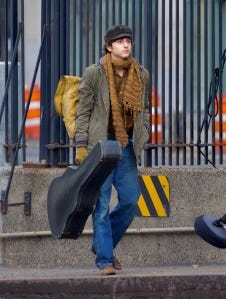
Chalamet fills in the blanks with his research, despite the writing not allowing him to show off all that he knows about this unfortunately excised year in Dylan’s youth. The actor knows the degree of transformation one can undergo as you age from 22 to 24. He tries to convey it in his performance, but the time jump is almost too large to reasonably traverse. We know little about he shape of Baez and Dylan’s relationship. They were complicatedly in love. She fed him “salad and red wine while [he] wrote like ticker tape” as they looked over at “the wild Pacific Ocean” together in Big Sur. The film shows him entering her room at the Chelsea Hotel, previously unannounced, not just for sex but for a quiet place to write. What happened? How did he get to that point, emotionally, where he simultaneously was groveling for Baez’s (and Russo’s) emotional and physical attention while disrespecting her individuality and artistry? The resonances of his interpersonal relationships are muddled because of that lost year. Mangold omits these crucial details, but somehow Chalamet bridges the gap which lead the audience along with him. This is my case for how Timothée Chalamet could win Best Actor.
Judas!
I said that this film is fundamentally about betrayal. I counted three: that against 1) Pete Seeger as a synecdoche for the folk music community 2) Joan Baez, and 3) Sylvie Russo. It appears as though all of these were supposed to be mutual, you could see how Bob Dylan was abandoned or strained by each of these people and how he committed offenses against them in response. Despite each of rebellions being split into different episodes, they all fall into the same category. Each of these people wanted Dylan to continue doing what he was doing, to remain artistically stagnant so as to raise consciousness of folk music’s the greater political cause, whereas Dylan sought continuous reinvention all the more because of that pressure to stay the same. This is a compelling and relatable moral quandary — should we prioritize the success and transformation of the individual or collective? Can the success of the individual lead to the success of the collective?, etc. This is why I wrote that A Complete Unknown gives insight into Dylan’s functional role in the culture of the Sixties. He could be held responsible, in part, for why rock music was popular music up until the end of the 20th century, and why folk, Americana, and country became termed “Alternative.” But the gravity of those betrayals were lost on me because I think the film either failed at convincing me that he loved or even cared for those people in the first place or fatally undercut the love we were told he had for them (I’m talking about the film’s final scene … a complete butchering).
I also wrote that I do not think this film will create more fans of Bob Dylan. More people will be inclined to turn on his music and listen, there will undoubtedly be more willing ears. But I think the effect of the film will be akin to the differences created between people whose fandom originates in the adaptation of some source material versus those who are fans of the original. When you are introduced to an character straightforwardly, as many biopics and film adaptations are forced to do, it becomes difficult to erase that persona from your understanding. For many of us, Pride and Prejudice‘s Elizabeth Bennet is Kiera Knightley, Twilight‘s Edward Cullen is Robert Pattinson (sorry). The Bob Dylan of the A Complete Unknown fan is Timothée Chalamet’s heartless, unduly righteous, slippery Judas marred by his conduct at Newport ’65. The beauty of his music is drawn out in the shiftiness of his character, his willingness and desire to be everyone and no one. I think that’s something that the real-life folk music community knew about him, but it’s a piece of knowledge denied to them in the film.
Maybe I’m instilling too little faith in audiences to deduce the great potential for nuance and change in the good guy/bad guy dichotomy. I’m not saying he’s a good guy. I’m just saying that the film doesn’t open up possibilities and avenues for interpretation, it shuts them down. Maybe you shouldn’t want to read a Bob Dylan biopic review from a Dylan fan.
There’s a movie about me opening soon called A Complete Unknown (what a title!). Timothee Chalamet is starring in the lead role. Timmy’s a brilliant actor so I’m sure he’s going to be completely believable as me. Or a younger me. Or some other me. The film’s taken from Elijah…
— Bob Dylan (@bobdylan) December 4, 2024
Happy New Year.